
Remember everything
you soak up online
Recall anything from that
scroll session three days ago?
Get automatic spaced repetition recall cards from the videos, podcasts, notes, PDFs, and articles you're already consuming. As automatic as retaining gets.
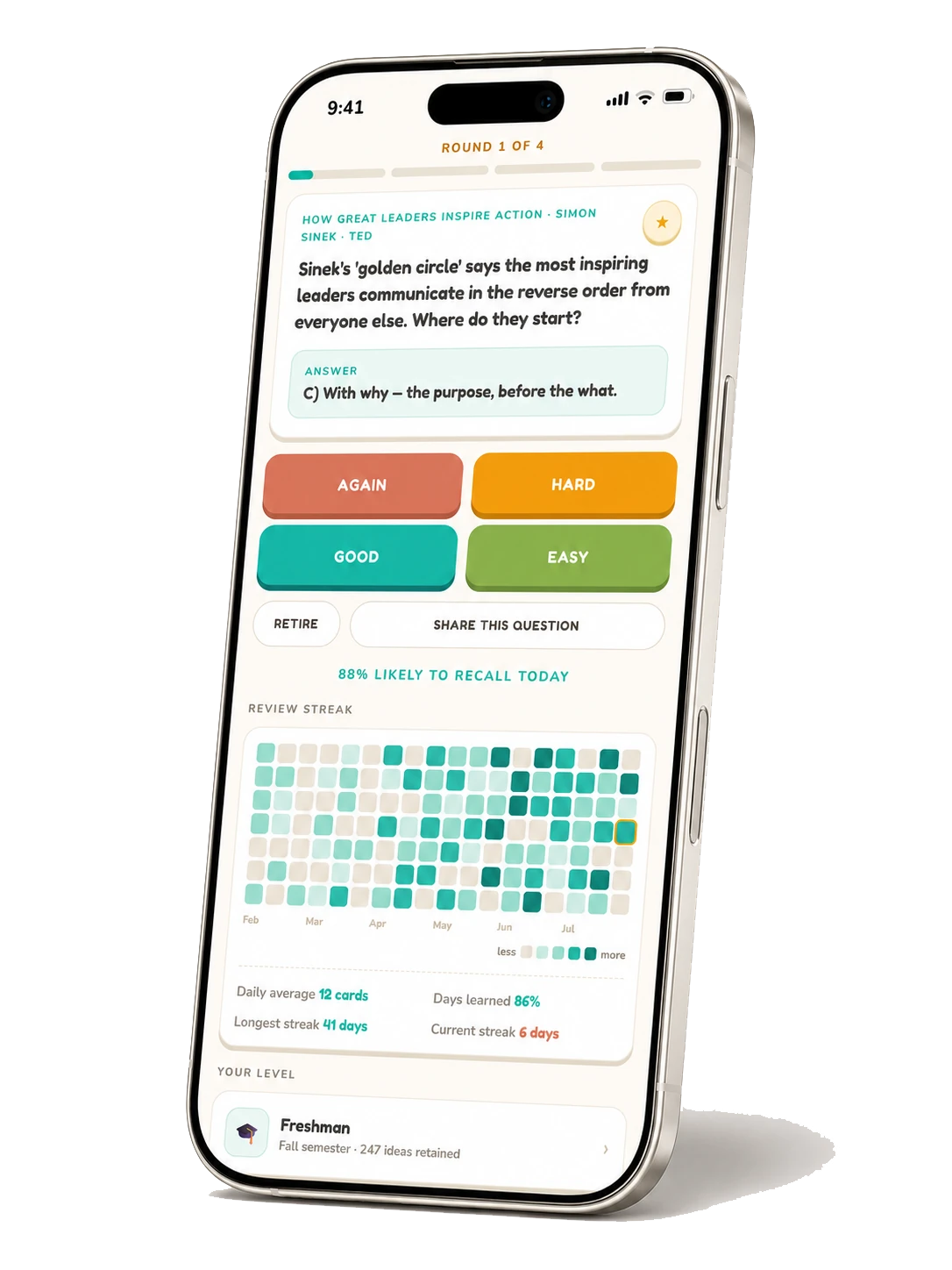
The average person spends45 waking daysa year on videos, podcasts, and articles.
and articles
See your mind grow in real time.
As you add sources, discover hidden patterns in your thinking.
Try it: Zoom out and in. Drag it. Tap any neuron.Backed by a century of science and some of the smartest people on the planet.
Here's what they say, in 34 quotes:
"Memory ceases to be a haphazard phenomenon, something you hope happens: spaced repetition systems make memory a choice."

"The spacing effect is one of the most dependable and replicable phenomena in experimental psychology."
"The long-term advantages of distributing practice sessions over time have been demonstrated repeatedly for more than a century."

"Repeated retrieval with long intervals between each test produced a 200% improvement in long-term retention relative to repeated retrieval with no spacing between tests."


"There is a mountain of evidence suggesting that spacing study time leads to better memory of the material."

"Periodic practice arrests forgetting, strengthens retrieval routes, and is essential for hanging onto the knowledge you want to gain."



"The spacing effect is one of the oldest and most reliable findings in research on human learning."

"Hundreds of studies in cognitive and educational psychology have demonstrated that spacing out repeated encounters with the material over time produces superior long-term learning, compared with repetitions that are massed together."

"The empirical evidence for the benefits of distributed (over massed) practice is overwhelming."

"The positive effects of spacing on long-term recall are large and robust, and have been demonstrated in a variety of domains."

"Delaying of reviews produces an actual increase in the efficiency of learning."

"Spacing presentations of to-be-learned information across time, rather than massing them, can have a very large positive effect on long-term retention."

"[Spaced repetition] offers something like a 20-fold improvement over (say) ordinary flashcards."

"Our experiments demonstrate that powerful spacing effects occur over practically meaningful time periods."
"The general conclusion is that the best retrieval schedules are those that involve wide spacing of retrieval attempts."

"Once you review, you can review less often. So I went on just to measure how often we need to review. Once I measured optimum intervals for review, I started using them in real life and it was just an avalanche of ideas for improvement since then."
"It sounds unassuming, but spaced repetition produces impressive results. [Students] who relied on a spaced approach to learning had nearly double the retention rate of students who studied the same material in a consolidated unit."

"The technique is called distributed learning or, more commonly, the spacing effect. People learn at least as much, and retain it much longer, when they distribute—or 'space'—their study time than when they concentrate it."

"Increased spacing of training sessions greatly enhances long-term retention of vocabulary."
"Whether students engage in retrieval practice over days, weeks, or months, research shows that any spacing is better than none."

"Left to itself every mental content gradually loses its capacity for being revived, or at least suffers loss in this regard under the influence of time."
"When retrieval practice is spaced, allowing some forgetting to occur between tests, it leads to stronger long-term retention than when it is massed."
"More than 100 years of distributed practice research have demonstrated that learning is powerfully affected by the temporal distribution of study time."

"Students will retain knowledge and skills for a longer period of time when they distribute their practice than when they mass it, even if they use the same amount of time massing and distributing their practice."
"Research shows that a delayed review typically has a large positive impact on the amount of information that is remembered much later."
"When you space out practice at a task and get a little rusty between sessions, or you interleave the practice of two or more subjects, retrieval is harder and feels less productive, but the effort produces longer lasting learning and enables more versatile application of it in later settings."
"The timing of learning sessions can have powerful effects on retention when study time is equated."
"We rated two strategies—practice testing and distributed practice—as the most effective of those we reviewed because they can help students regardless of age, they can enhance learning and comprehension of a large range of materials, and, most important, they can boost student achievement."
"The longer intervals yield substantially higher recall in spite of their adverse effects on acquisition."
"When learning is harder, it's stronger and lasts longer."
"Using memory changes memory—and for the better. Forgetting enables and deepens learning, by filtering out distracting information and by allowing some breakdown that, after reuse, drives retrieval and storage strength higher than they were originally."
"Spaced retrieval practice (that is, practicing retrieval at fairly long intervals) really helps long-term memory."
"Only 12 of 271 comparisons of massed and spaced performance showed no effect or a negative effect from spacing, making the spacing effect quite robust."
"[Spaced repetition] makes memory a choice."
How it works:
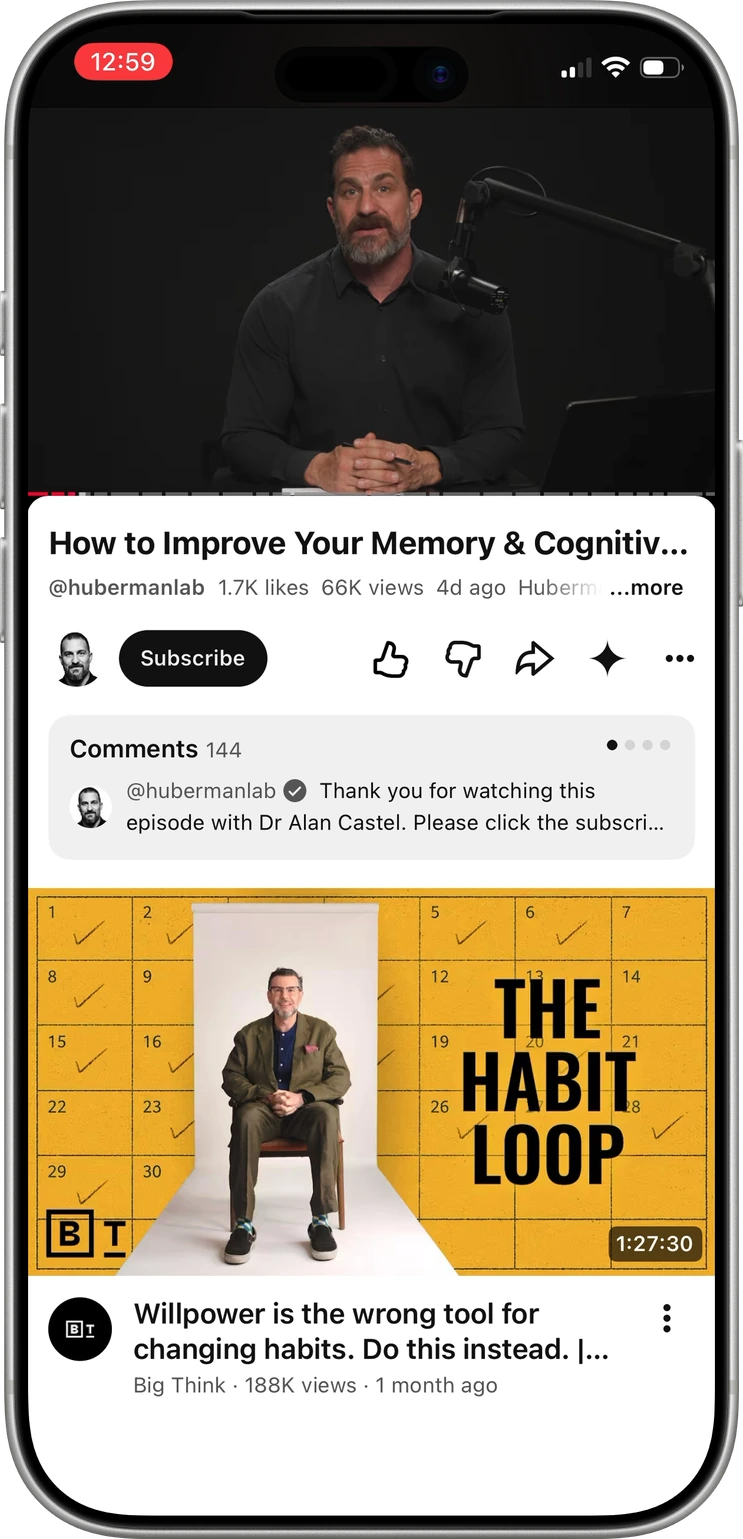
Share a content that you want to remember forever to BrainRetain.

BrainRetain processes your source through 11 proprietary layers to minimize AI hallucinations. Cards show the source quote they came from, so you can check them yourself.
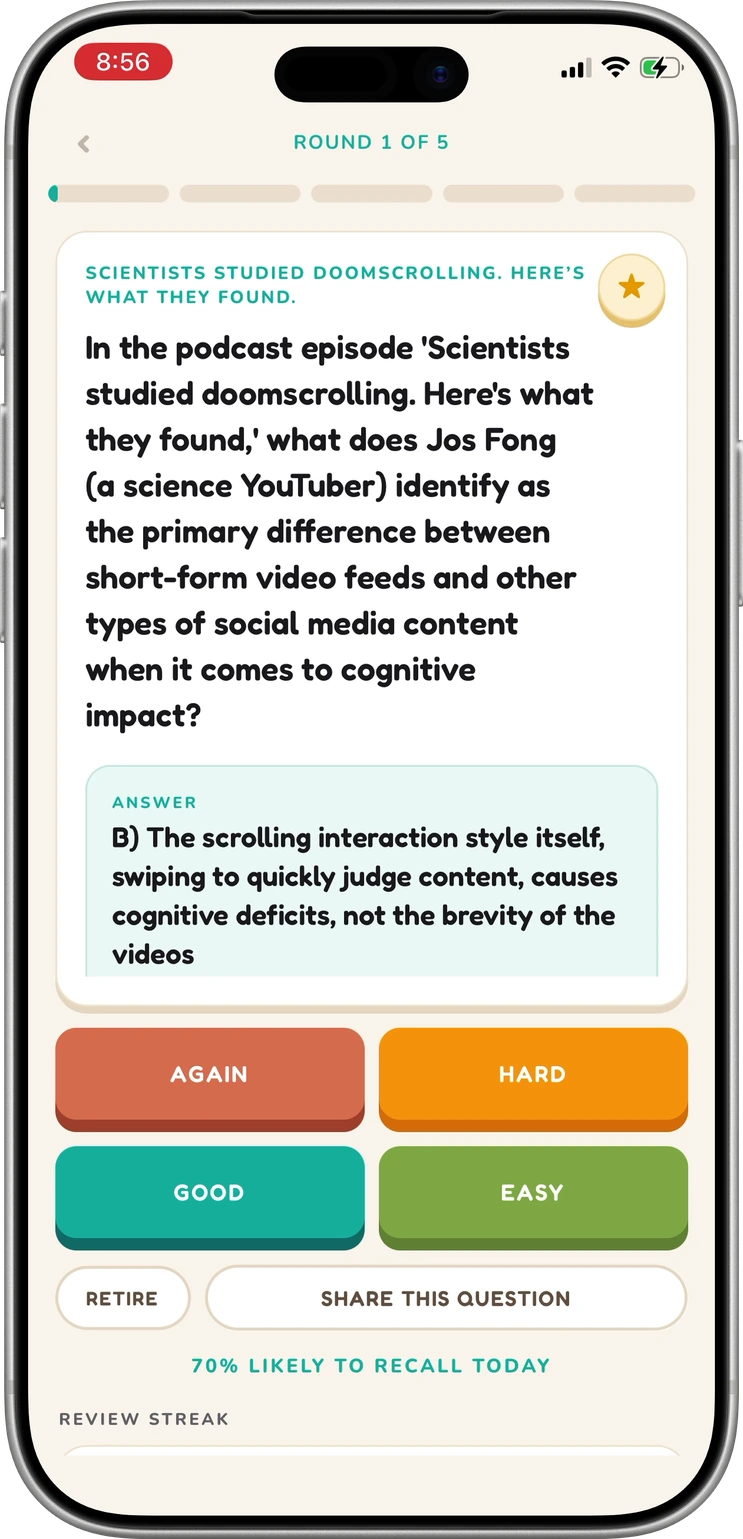
We will ask you to recall it,
and you rate how well you remembered.
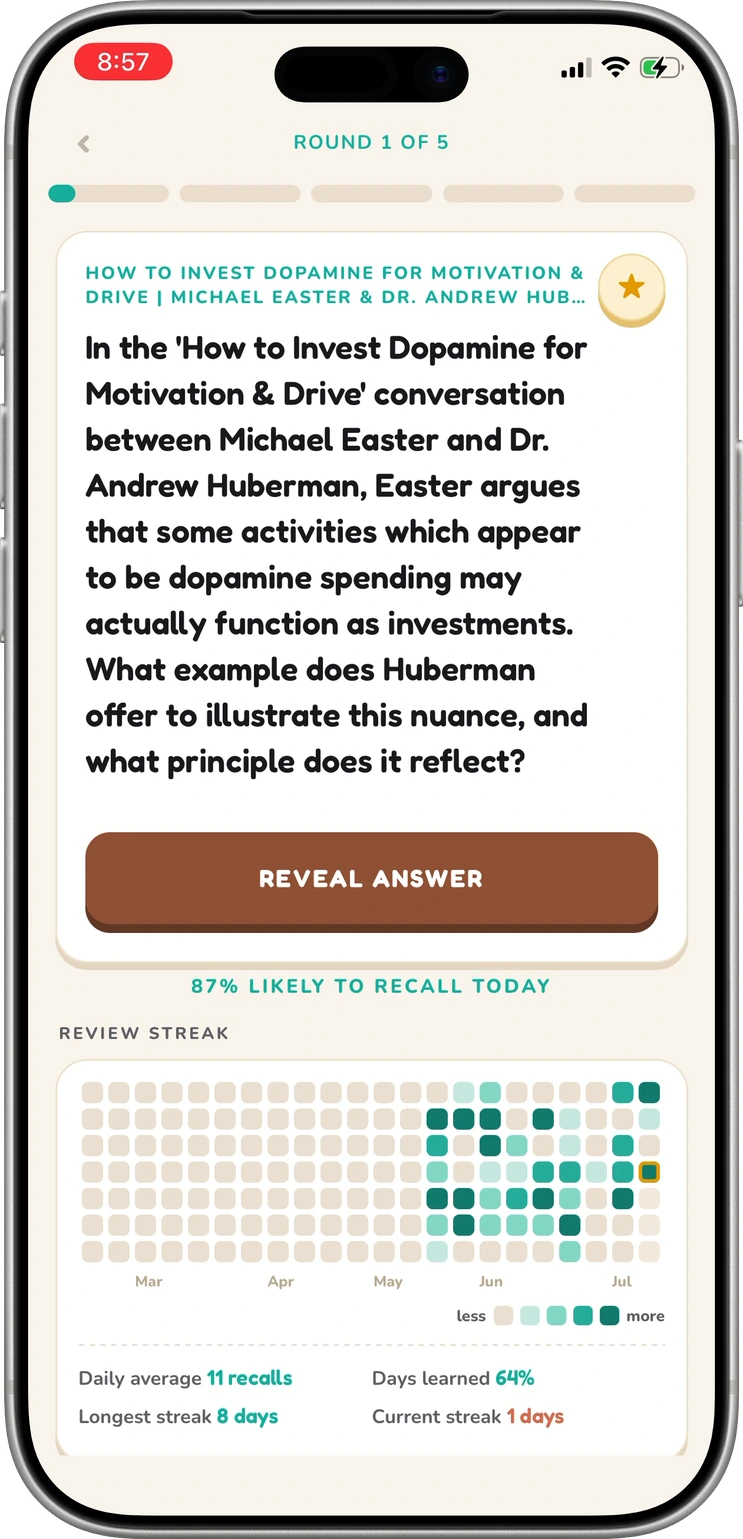
Based on your answer, the algorithm updates your memory forecast. Its 21 parameters turn it into one rule: ask again sooner if it was hard, later if it was easy.
BrainRetain runs on the latest spaced-repetition technology, from the same family of algorithms used in Anki.
medical students, every year, trust spaced repetition to retain what they learn.
people across 317 experiments confirm spaced repetition is a superior method for retaining information.
FAQ:
YouTube, Spotify, Apple Podcasts, TikTok, Medium, Wikipedia, Substack, blogs, and news articles (ungated for mobile). If it has a share button, it likely works with BrainRetain.
BrainRetain generates recall cards from whatever you share, and you decide whether or not you want to edit them. You also get a point-by-point summary, so you can pick which bullets to turn into recall cards as well.
It is a review method that times each repeat exposure to land right before you would naturally forget it. It is based on the forgetting curve (the drop in memory that follows learning something new) and an algorithm that pushes your next review further out when you get something right and pulls it closer when you do not. Over time the gaps stretch from days to weeks to months, and the memory gets sturdier at every step. It works because it is timed to how your brain actually forgets instead of a fixed schedule, which is why it consistently beats cramming in head-to-head studies.
A few minutes a day; reviews are short.
Yes, your library is yours. We don't sell your data, and your collections stay private to you.
If a YouTube video was watched, but none was retained, was the video watched?
Download BrainRetain now.